
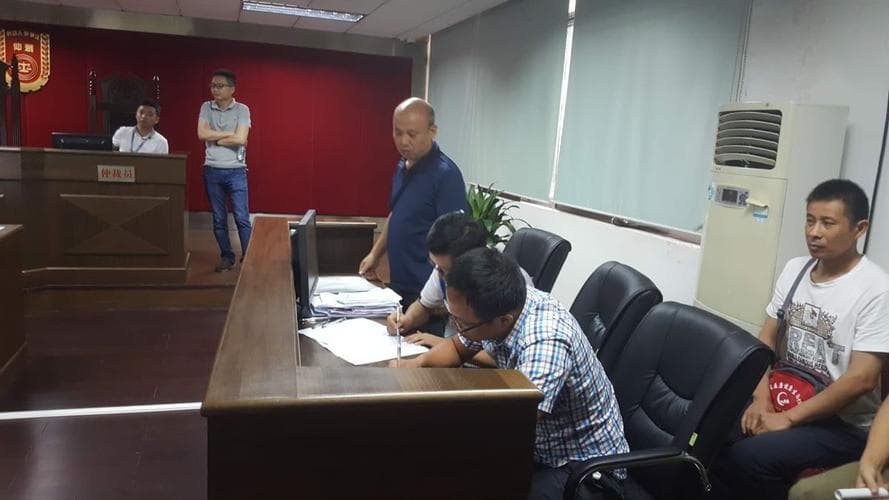
In the previous parts, I recounted my journey from applying for labor arbitration to the first instance trial, and then the second instance. Throughout this process, the second instance was actually the simplest. This article describes the online court hearing for the second instance.
Recap of Previous Events
Since the timeline is quite long, friends who haven't read the previous nine articles may not be familiar with the earlier situation. Here I'll recap the timeline to give you a general understanding. For details of the previous process, please go back and read the earlier articles in this series.
- March 2, 2021: Case filed to start labor arbitration
- May 21, 2021: Evidence submitted
- May 24, 2021: Labor arbitration court hearing
- July 12, 2021: Received the arbitration award, and learned that the company appealed the award.
- September 24, 2021: Received notice from Beijing Chaoyang People's Court to pick up the first instance summons.
- October 12, 2021: First instance trial at Beijing Chaoyang People's Court.
- January 5, 2022: Received the written first instance judgment (the effective date of the first instance judgment started from this time).
- January 18, 2022: The company wrote the second instance appeal and mailed it. The second instance process began.
- June 28, 2022: Second instance trial. Received the second instance judgment 4 days later (July 2). Full victory in labor arbitration.
Second Instance Filing Notice
In early June, I received a call from the clerk. She said: "After multiple communications and coordination, I have just uploaded your case to the Third Intermediate Court today. Hereby I inform you." I sincerely said, "Thank you very much." That day marked the end of what I called the "5-month delay in transferring the second instance case file." It was really tough. After hanging up, I just let out a sigh.
On the evening of June 10, with nothing else to do, I opened the "People's Court Online Service Beijing" mini-program. I saw my second instance case there! The status was "not yet concluded." At that moment, the "thread" of this event that I had been holding onto in my heart finally got released. The second instance had been filed! It was filed! My "holding on" and "worrying" partly showed how much I valued this matter; partly reflected my strong obsession with "pushing project progress" and "achieving goals"; and partly demonstrated my lack of trust in the government—I always worried they wouldn't handle things with due diligence and would delay me.
For the next 10 days, I was on vacation. Since my lawyer friend (a schoolmate) said: "The second instance is very fast—from filing to trial to judgment is quick," I kept an eye on my phone for calls during my vacation.
On June 13, I received a call from the Third Intermediate Court. A man with a very Beijing-accented Mandarin informed me of the trial time and asked what kind of phone I was using? It turned out to be an online trial, and since the relevant app isn't available on iPhones, he told me to use the "Beijing Court Cloud Courtroom" WeChat mini-program at that time.
Originally, the scheduled time was the afternoon of June 24 (Friday). The next day, another woman called to inform me of a change in the trial time. I asked why the change. She said the judge had an important meeting that day. So we negotiated and moved the time to the afternoon of June 28.
Since I worried that this call might be from someone from the company trying to disrupt me, I called the judge's assistant the next day to confirm this matter (I had the judge's assistant's phone number via previous text messages and emails; here, I also recommend that if you encounter such a situation, you must find the right person to reconfirm).
The Second Instance Court Hearing Process
At 3:00 PM on June 28, 2022, I opened the "Beijing Court Cloud Courtroom" mini-program on time. Friendly reminder: if you also need a similar online trial, remember two things: make sure your phone is fully charged, and open the relevant software in advance to complete registration and enable camera and microphone permissions, etc.
Just a few minutes after I entered the mini-program, my phone froze and shut down. I don't know why. Fortunately, the judge hadn't entered yet, and the trial hadn't started.
However, after half an hour, the judge still hadn't appeared. I was using my own phone to keep the video open, and I borrowed another phone to call the judge's assistant, saying I had been waiting for half an hour and didn't know what was going on. The judge's assistant said: "The judge's previous case isn't finished yet. Please wait." In fact, I waited for an hour and the trial still hadn't started. Later, I called the judge's assistant again to ask. They said, "Don't rush." I said, "I'm not rushing you; I'm worried about missing the trial." The judge's assistant said, "Don't worry, we won't start without you. Just wait patiently. I'll call you to come online later."
Another half hour passed, and the judge called: "Is this xx? I'm the judge. Come online now!" I quickly found an empty meeting room and started immediately.
First, the judge read the relevant court discipline, open trial regulations, and asked whether we wanted to recuse ourselves, etc. That part was fine—if you heard it clearly, just say "I heard it clearly." As for "whether to recuse," just say no—if you're already there, why would you recuse.
Then the judge very concisely stated the case process from arbitration to the first instance. The speech was fast and succinct, seeming very skilled and professional. Then the judge said: "The dispute in this case is whether the company considers the termination lawful, and the party xx considers it unlawful." The judge then questioned the company and me separately. The company said: "We negotiated with him; there are chat records as evidence. We reached an agreement, but he backed out. The company's termination was lawful, willing to pay severance pay (economic compensation), but unwilling to pay compensation for unlawful termination..."
I argued: "The company issued a written termination notice to me on a certain day. The chat record is from the evening of that day. That is, the company first issued a unilateral termination to me, and then there was the so-called negotiation record mentioned by the company just now. Moreover, the chat record is missing some key conversations, and I never signed any agreement showing mutual consent. The company first issued a unilateral termination notice; the negotiation chat record they mentioned was from the evening after the termination. That negotiation is completely invalid and meaningless. Therefore, I insist that the company's termination was unlawful and they must pay me compensation for unlawful termination."
Obviously, my response had a key point. I repeated: "the termination was issued first, and only then did the so-called evidence of negotiation with me appear" (Actually, when I repeated this concept a second time, the judge said: "xx, I understand; you don't need to repeat it.") After I finished answering, the judge asked: "Company H, did you give xx a termination notice 30 days in advance, or announce immediate termination on the day?" The company's representative said: "Yes." The judge continued: "Was the chat record from the evening of a certain date?" The company's representative said: "Yes." The judge said: "Oh, so you terminated xx and then negotiated with him? Do you think that counts as lawful termination?"
Later, the judge asked both parties if they had new evidence. The company's representative said: "Too much time has passed; we only have this evidence available." I found that amusing after hearing it that day. Then the judge asked me if I had new evidence: I said no. Actually, I had a lot of evidence never submitted before, but it no longer mattered. I didn't need to submit any evidence; the other side had already collapsed on their own.
After that, the judge read out a bunch of stuff and sent us the trial record to review. The trial record was also within the mini-program. The screen, which previously showed the video, automatically opened a new page. I quickly skimmed through the trial content. It was very concise; the court reporter's ability to abstract text was quite good, effectively summarizing the company representative's rambling. My responses were recorded almost verbatim, with little reduction, because I had already spoken concisely and focused on key points without any irrelevant talk.
After reading, I said: "Your Honor, I have finished reviewing the trial record." Then the company representative also finished. The judge said: "Flip to the last page to confirm the contact information and service address." We verbally replied, confirming the address and contact info were correct. The judge said: "Wait a moment; I'll operate it, and you will see a signature button on the page. Sign and write the date." At that point, a button appeared at the bottom of the page. I signed and wrote the date.
Then the judge said the trial was over, and the mini-program video screen automatically closed, jumping to a page that displayed the entire trial duration: 14 minutes and 22 seconds.
From Second Instance Trial to Receiving the Judgment: Only 5 Days!
After the trial ended a little after 5 PM on June 28, I thought: according to my lawyer friend's estimate, I should receive the judgment by the end of July. Unexpectedly, on the morning of July 2, I received the judgment. I was stunned—the speed was incredible. The delivery was still via Postal Court Special Delivery.
Previously, I had received three such mailings: the first instance summons, the first instance judgment, and the second instance complaint. But they all arrived on weekdays. The postal delivery person would contact me, and I would call my roommate, who signed for the mail while the courier stayed on the phone with me.
This time, the second instance judgment arrived on a Saturday morning, so I could sign for it myself. I tore open the envelope, flipped to the last page, and saw: "Appeal denied, original judgment affirmed." Victory without any suspense.
Afterword
The next step is to see if the company will transfer the money as required. If they don't, I'll have to apply for enforcement, which I've heard is also time-consuming. At this point, my labor arbitration has only taken a little over a year. I still remember during the arbitration stage, the mediator tried to persuade me to compromise by saying: "If you ask for less money, I can help you negotiate with the company. If you refuse to give in, the company can drag you through the first and second instances for three years." Looking back now, "it's not so bad, after all."
I also have a few colleagues who are going through arbitration. When we all get our 2N compensation, it should teach that idiot company a lesson, right?