Labor Arbitration Memoir (VI): First Trial Hearing

Labor Arbitration Memoir (VI): First Trial Hearing

Personal full-record of labor arbitration

Last updated 3/17/2022 11:31 PM
逃离沙漠
13 min read
Category
Sharing
Tags
Labor Arbitration

Disclaimer: This article only records my personal experience with the first instance of labor arbitration. The statements and conversations are written based on memory and recall, and I cannot guarantee that the content matches the actual conversations word for word. The described content and scenes include personal feelings and may not be consistent with objective reality. The opinions expressed are purely personal and do not represent my evaluation of any individual or organization. I am not responsible for any consequences. Please browse the relevant content selectively.

In the previous sections, I described how I filed the case on March 2, 2021, submitted evidence on May 21, had the hearing on May 24, received the arbitration award on July 12, and learned that the company had appealed the decision. Then I had to wait for the first instance trial.

Receiving the Summons

On September 24, 2021, at 9:16 AM, I was transferring between subway lines when I suddenly felt my phone vibrating frequently in my pocket. Judging by the vibration pattern, it definitely wasn't a WeChat message—it was a phone call. At that moment, I thought, "This must be the court calling." Since it was too noisy and crowded, I quickly found a corner and answered the call. It was indeed the court. Although I could barely hear, I roughly understood they were asking me to pick up the court summons. Because I couldn't hear clearly, I repeatedly asked for the location, and the person on the other end kindly repeated it several times: "Chaoyang Park South Road, Yard No. A-2, exit D2 of Chaoyang Park Subway Station, D as in ABCD." I said, "Thank you, I've got it." I also asked about their afternoon office hours, and they replied, "1:30 PM to 4:00 PM." I responded, "I'll arrive between 1:30 and 2:00." They said, "Okay, remember, when you get here, don't queue up—just call me." (Phone number: 010-85998646)

After lunch, I headed over. When I arrived at the Chaoyang Court entrance, I saw many people queuing, and I understood why they told me not to queue and just call them. I arrived at 1:10 PM and tried calling, but no one answered. Then I noticed employees entering one by one through a side door with their access cards, presumably just returning home from lunch. At 1:29 PM, I called again, and someone answered quickly. I gave my name and purpose, and the person said, "Face the national flag, walk about 5 meters to your right, and wait for me there." A few minutes later, a court staff member came out—a woman, about 1.6 meters tall, with short hair, around 40 years old, quite slim. She handed me some forms to fill out and sign. It was drizzling at the time, so she held my umbrella while I crouched down and filled out the forms on my thigh. Some raindrops fell on the paper and smudged my handwriting, but it was still readable.

I won't post a photo of the summons, but its contents consist of three parts:

  • The first page of the summons, labeled "Civil Summons from Chaoyang People's Court." The back has relevant instructions.
  • The company's complaint.
  • The corresponding copy of the labor arbitration award.

Preparing the Defense

Since I received the court summons right before the National Day holiday and I was busy those days, I didn't have time to prepare anything—I just read through the summons.

Because the National Day holiday was quite long, to avoid any surprises, I made copies of all the materials I had, keeping one copy at home, one at the office, and carrying the originals on me. Then I enjoyed a 9-day mini-vacation.

During the holiday at home, I didn't prepare anything—I just wanted to relax. After returning to Beijing on October 8th, I started searching for relevant information and planned to write a "Defense Statement." I want to remind everyone here that writing a defense statement is very important. Prepare it in advance so that when you go to court, you can submit it to the judge. This prevents omissions during "on-the-spot performance" or adverse outcomes due to nervousness or other reasons that might cause you to "perform poorly."

(The defense statement I wrote—reply with "Defense Statement" to get it. Disclaimer: This defense statement was given to me by a lawyer friend. It is for reference only for those who need it. I am not responsible for any consequences.)

First Instance Hearing

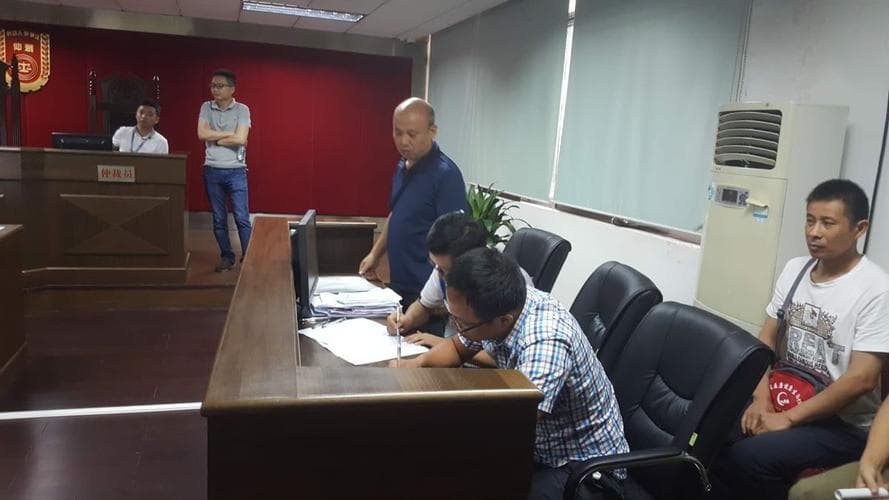
The judge scheduled the hearing for October 12, 2021, at 10:30 AM. I arrived at the court entrance at about 9:40 AM. The security guard asked for my ID and the court number and hearing room number. Then he checked his list and said, "Your name isn't here—call the judge." I glanced at his list and immediately saw my name, pointing it out to the guard. After that, he let me in only after scanning my Beijing Health Kit and travel itinerary code.

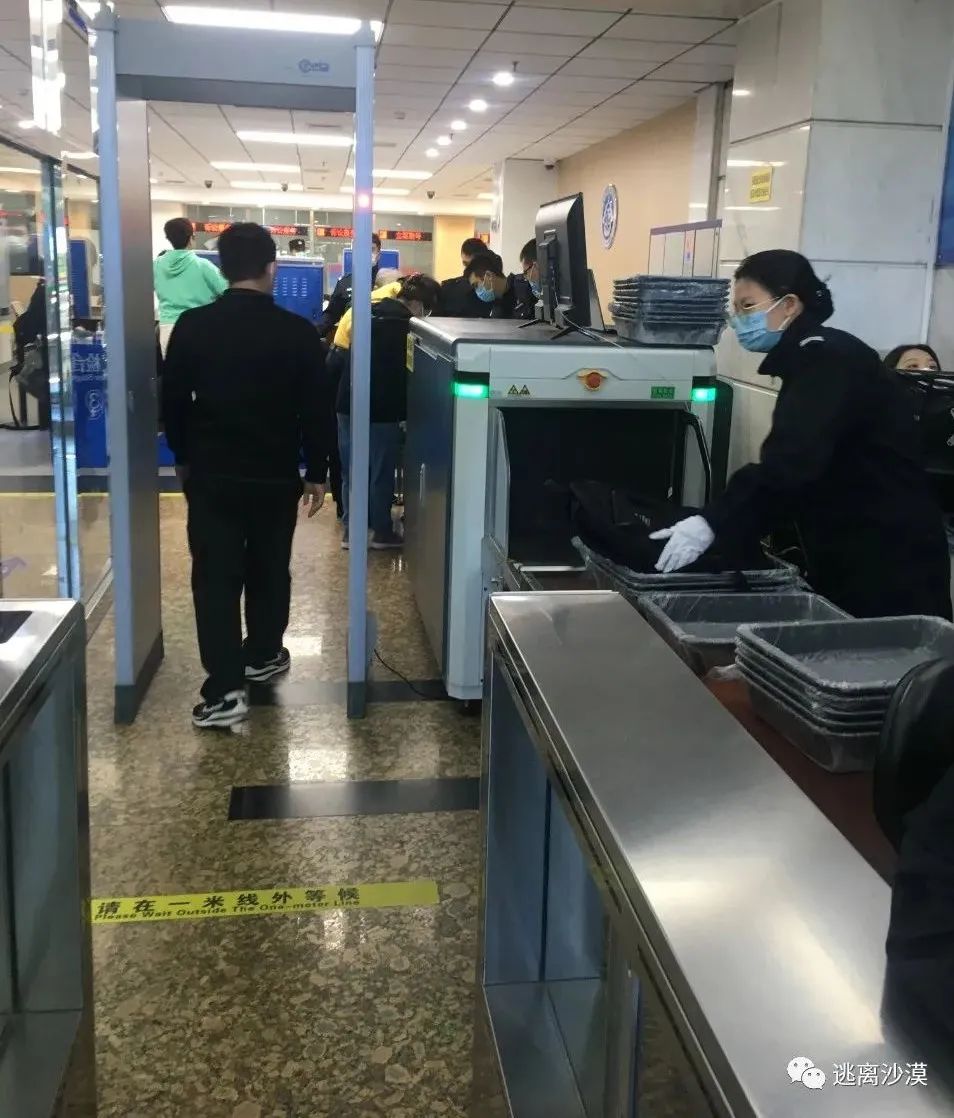
Once inside, a staff member asked for my original ID, had me remove my mask to confirm my identity, and then directed me to security screening. The security check here was as strict as airport security: I had to open my backpack, but the documents inside didn't need to be taken out; the laptop had to be placed separately in a tray, and metal items, electronics, power banks, cables, etc., in another tray. So my belongings went through security in three trays, while I had to unzip my jacket and stand on a platform for a full 360-degree pat-down. Even a small earphone in my pocket had to be taken out for inspection.

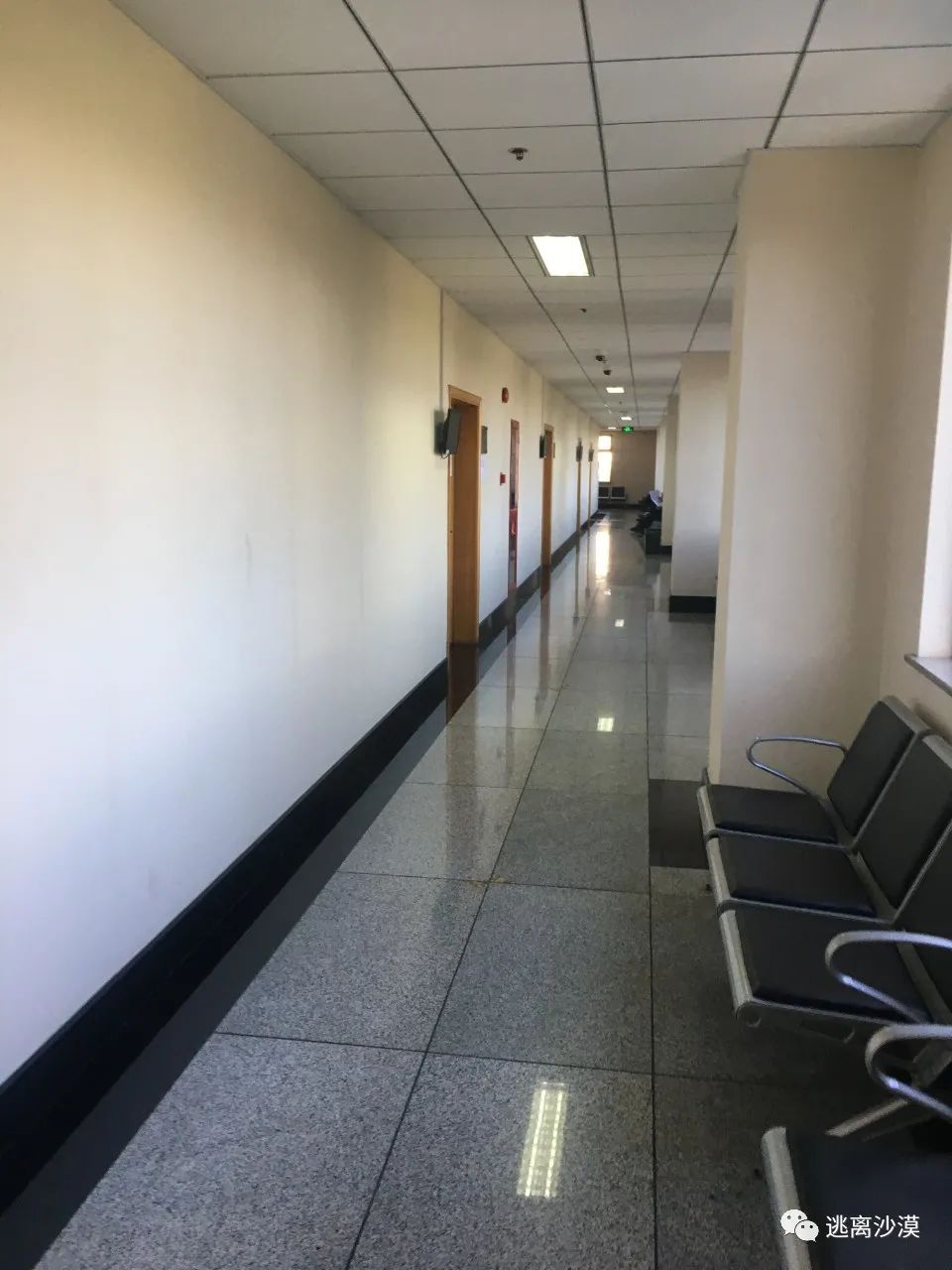
When I arrived at the courtroom door, it was open, and the case inside was in the negotiation phase. I could hear them arguing about performance bonuses in the hallway. The picture below shows the hallway—each door leads to a small courtroom, not very large.

Outside my assigned courtroom, there was a restless person who kept calling someone unsuccessfully and continuously redialing. I initially thought he was the company's lawyer, but after a few minutes, he asked me, "What time is your hearing?" I said, "10:30." He replied, "Mine was at 9:30. I arrived at 9 and have been waiting ever since..." Only then did I realize that the two preceding cases had dragged on due to disputes. During the wait, I chatted with this person for a while. He was a lawyer representing a company in court. Soon after, the defendant in his case also arrived. The three of us sat together and talked a lot. I also briefly exchanged words with other lawyers and got a glimpse of different cases.

Around 11:00, it seemed that the people inside the courtroom were about to reach a mediation agreement. The judge took this break to check if the next parties had arrived. I seized the opportunity to ask, "I'm [name]. When will my case start?" The judge said, "Are you the one with [company name]?" I said, "Yes." The judge asked, "Are you willing to mediate?" I said, "No." The judge said, "It's just [amount] yuan short—you won't mediate even for that?" I said, "Yes, not a penny less." Then the judge closed the door and continued mediating the previous case, while the two parties inside were calculating amounts and signing documents. I was puzzled: "Why is the attitude like this? This isn't what I expected."

Soon after, the previous pair also went in for mediation, so the judge came out to ask me and the company's representative, "Are you willing to mediate?" The company's representative said, "We can mediate if you reduce the amount a bit." I said, "Not a penny less." The judge said to the company's representative, "Talk it over with him properly," and then closed the door.

Then the company's representative, while reporting to the company's management, said, "The company's management still hopes you can make a concession—reduce the amount a bit." I said, "Not a single cent less." The company's representative said, "If that's the case, the company will continue to appeal." I said, "Then go ahead and appeal—I'll go with you all the way to the Supreme People's Court."

Before the hearing began, the judge spoke with me privately again, hoping I would compromise and reduce the amount by 7,000 yuan so they could negotiate with the company. The judge said that if I didn't agree, after today's hearing, the company might continue to appeal, which would drag on for a long time and wasn't worth it for me. The judge said a lot, appealing to my emotions and reason, and added, "I can see you're quite serious" (you know the implication, right?). I still politely insisted that not a single cent could be reduced. The judge seemed a bit displeased, immediately returned to their seat, and said with a slight tone, "Let's start the hearing then," and called the company's representative in. Then, at a very fast pace, they began the opening statements of the hearing.

I won't go into details about the hearing itself. I had my defense statement ready and read it aloud. The other side was basically just going through the motions to waste time, offering a few simple rebuttals. In the middle, the judge asked me if I had evidence to present. I said yes. The judge, annoyed, said, "Don't you know the rules?! Didn't I tell you earlier (during the private talk) that you don't need evidence?" I said, "Okay." Near the end of the hearing, the judge asked if either side had anything to add. I said, "Actually, during the arbitration process..." I had just started when the judge interrupted, "There's no need to say that!" I stopped. I thought, "The judge won't let me submit evidence—this doesn't feel right." I said, "Your Honor, I still want to submit a piece of evidence." The judge snapped again, "Didn't I tell you? You don't need evidence!" I said, "I'm afraid there might be unclear points—I'd like to submit it anyway!" The judge said, "What could be unclear? Don't you need to understand?" I said, "Okay."

Then the clerk printed the hearing transcript and handed it to both parties for confirmation. If there were no issues, we were to sign each page front and back. The first version had missing content; the second version had the content added but with a wrong time—I pointed it out, and the clerk corrected it again. The third version was barely acceptable. There was one part I wasn't satisfied with, and I said, "This part is slightly different from what I meant. I'd like it changed to '[specific wording]'." The judge said, "No need, it's the same." So I had no choice but to sign. (The transcript was wrong twice—what do you think? How would you see it?) The hearing ended around 12:15 PM.

Summary

If you unfortunately go through labor arbitration and persevere to the first instance, I advise you to take it seriously yourself, even if you have a lawyer (Why do I say that? Remember the person I mentioned at the beginning who seemed anxious and kept calling? He was a lawyer. Why was he calling? Because he forgot some documents. When we were chatting, he left midway and came back with a package from SF Express 1-hour delivery). Treat yourself as your own ultimate authority—rely on yourself, not on others. Carefully prepare your evidence, write a solid defense statement, and go into "battle" meticulously and unwaveringly.

(If you think what I've written is helpful to you or others, please feel free to share it. The more people see it, the more will be fully prepared to "fight" and "win," and perhaps it can contribute to improving certain aspects.)

Keep Exploring

Related Reading

More Articles
Recent update 5/18/2026

枝见 Zhijian: A Markdown Mind Map Editor Built with Avalonia

This article introduces Zhijian, a local mind map editor based on Avalonia, supporting blank creation, folder loading, precise onboarding guidance, macOS shortcut adaptation, outline/Markdown/mind map synchronization, node notes, thumbnails, zoom, canvas dragging, and Markdown/OPML/XMind file exchange.

Continue Reading