
大家好,我是沙漠尽头的狼。在朋友圈看到桂素伟大佬发的喜讯截图,站长赶紧翻译向大家报喜,确定了-C#是 2023 年度的编程语言!
在 TIOBE 指数的历史上,C#首次获得了年度编程语言的奖项。祝贺!二十多年来,C#一直是前 10 名的选手,现在它正在追赶四大语言,它以一年内最大的涨幅(+1.43%)赢得了这一当之无愧的奖项。紧随其后的是 Scratch(+0.83%)和 Fortran(+0.64%)。C#正在蚕食 Java 的市场份额,并且在诸如 Web 应用程序后端和游戏(感谢 Unity)等领域中越来越受欢迎。C#可以免费使用(站长注:.NET 是 MIT 协议开源,免费跨平台,信创没问题),并以稳定的速度发展,使该语言在每个新版本中都更具表现力。C#将继续存在,甚至可能很快超越 Java。
除了 C#之外,去年 TIOBE 指数中还有许多有趣的变化。Fortran 和 Kotlin 成为了前 20 名的永久选手,取代了长期受欢迎的 R 和 Perl。Fortran 非常适合使用优秀的库来处理数字,并且在许多领域仍然是大学的宠儿。Kotlin 是 Java 的易于学习/编写的竞争对手。一个有趣的问题是:2024 年哪些语言将进入 TIOBE 指数前 20 名?这很难预测。Julia 在 2023 年短暂触及了 TIOBE 指数,但未能保持该位置。Julia 语言和社区的成熟需要获得第二次机会。我会把赌注押在 Dart(与 Flutter 一起)和 TypeScript 上。后者已经在工业中得到了大量使用,但由于某种原因,它尚未突破 TIOBE 指数。让我们看看 2024 年有什么。 -- TIOBE 软件首席执行官 Paul Jansen
TIOBE 编程社区指数是编程语言受欢迎程度的指标。该指数每月更新一次。评级基于全球范围内的熟练工程师、课程和第三方供应商的数量。诸如 Google、Bing、Yahoo!、Wikipedia、Amazon、YouTube 和 Baidu 等流行搜索引擎被用于计算评级。值得注意的是,TIOBE 指数并不是关于最好的编程语言或编写最多代码行的语言。
该指数可用于检查您的编程技能是否仍然是最新的,或者就构建新软件系统时应采用哪种编程语言做出战略决策。TIOBE 指数的定义可以在这里找到。
| 2024 年 1 月 | 2023 年 1 月 | 变化 | 编程语言 Logo | 编程语言 | 评级 | 变化 |
|---|---|---|---|---|---|---|
| 1 | 1 |  |
Python | 13.97% | -2.39% | |
| 2 | 2 |  |
C | 11.44% | -4.81% | |
| 3 | 3 |  |
C++ | 9.96% | -2.95% | |
| 4 | 4 |  |
Java | 7.87% | -4.34% | |
| 5 | 5 |  |
C# | 7.16% | +1.43% | |
| 6 | 7 |  |
 |
JavaScript | 2.77% | -0.11% |
| 7 | 10 | |
 |
PHP | 1.79% | +0.40% |
| 8 | 6 |  |
 |
Visual Basic | 1.60% | -3.04% |
| 9 | 8 | |
 |
SQL | 1.46% | -1.04% |
| 10 | 20 |  |
 |
Scratch | 1.44% | +0.86% |
| 11 | 12 | |
 |
Go | 1.38% | +0.23% |
| 12 | 27 | |
 |
Fortran | 1.09% | +0.64% |
| 13 | 17 | |
 |
Delphi/Object Pascal | 1.09% | +0.36% |
| 14 | 15 | |
 |
MATLAB | 0.97% | +0.06% |
| 15 | 9 |  |
 |
Assembly language | 0.92% | -0.68% |
| 16 | 11 | |
 |
Swift | 0.89% | -0.31% |
| 17 | 25 | |
 |
Kotlin | 0.85% | +0.37% |
| 18 | 16 | |
 |
Ruby | 0.80% | +0.01% |
| 19 | 18 | |
 |
Rust | 0.79% | +0.18% |
| 20 | 31 | |
 |
COBOL | 0.78% | +0.45% |
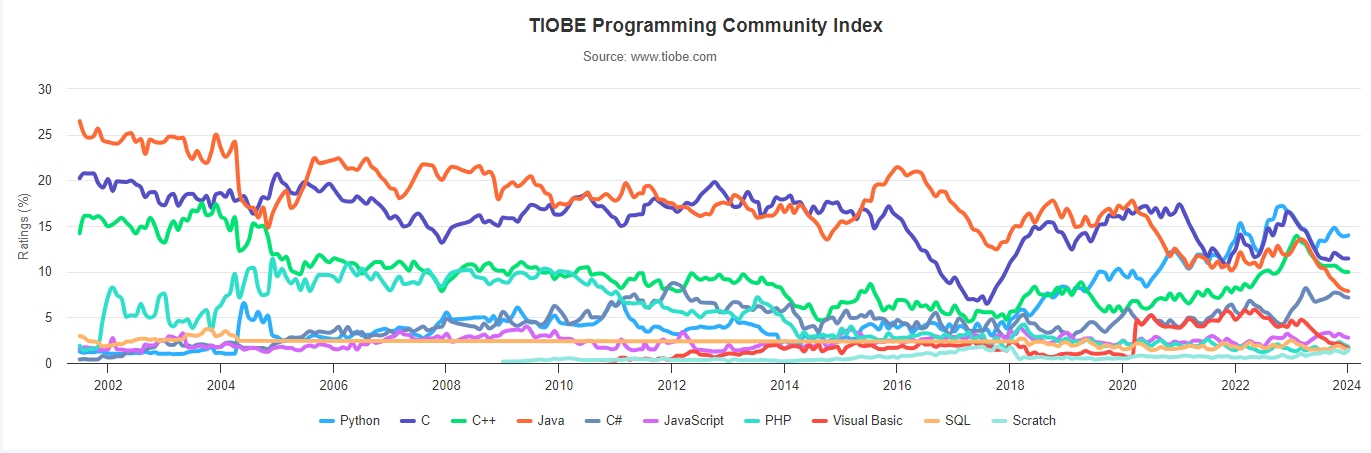
其他编程语言
下面是完整的前 50 名编程语言列表。此概述是非官方发布的,因为可能存在我们错过的语言。如果您觉得缺少某种编程语言,请通知我们 tpci@tiobe.com。另请查看我们监视的所有编程语言的概述。
| 排名 | 编程语言 | 评级 |
|---|---|---|
| 21 | D | 0.77% |
| 22 | F# | 0.77% |
| 23 | R | 0.74% |
| 24 | SAS | 0.70% |
| 25 | (Visual) FoxPro | 0.67% |
| 26 | Ada | 0.62% |
| 27 | Classic Visual Basic | 0.60% |
| 28 | Prolog | 0.56% |
| 29 | VBScript | 0.55% |
| 30 | Perl | 0.52% |
| 31 | Objective-C | 0.46% |
| 32 | Dart | 0.43% |
| 33 | Julia | 0.40% |
| 34 | X++ | 0.39% |
| 35 | TypeScript | 0.39% |
| 36 | Lua | 0.37% |
| 37 | Scala | 0.34% |
| 38 | GAMS | 0.33% |
| 39 | Transact-SQL | 0.30% |
| 40 | Logo | 0.30% |
| 41 | ABAP | 0.29% |
| 42 | Lisp | 0.28% |
| 43 | CFML | 0.28% |
| 44 | Haskell | 0.28% |
| 45 | PL/SQL | 0.27% |
| 46 | Awk | 0.27% |
| 47 | Eiffel | 0.24% |
| 48 | Smalltalk | 0.23% |
| 49 | ML | 0.23% |
| 50 | ActionScript | 0.23% |
接下来的 50 种编程语言
以下列表表示第 51 到第 100 的语言。由于差异相对较小,编程语言仅按字母顺序列出。
- Algol、AutoLISP、Avenue、Bash、bc、Boo、CIL、CL (OS/400)、CLIPS、Clojure、CLU、Curl、DiBOL、Erlang、Forth、Hack、Icon、Io、J、J#、JScript、LabVIEW、Ladder Logic、Lingo、LiveCode、M4、Maple、MQL5、NATURAL、Nim、OpenEdge ABL、PL/I、PostScript、PowerShell、Pure Data、Q、Racket、REXX、Ring、RPG、Scheme、Snap!、Solidity、SPARK、SPSS、Squirrel、Stata、Wolfram、Xojo、XQuery
相当长的历史
要了解更大的图景,请查找下面多年来前 10 名编程语言的位置。请注意,这些都是平均值。
| 编程语言 | 2024 | 2019 | 2014 | 2009 | 2004 | 1999 | 1994 | 1989 |
|---|---|---|---|---|---|---|---|---|
| Python | 1 | 4 | 8 | 6 | 11 | 22 | 22 | - |
| C | 2 | 2 | 1 | 2 | 2 | 1 | 1 | 1 |
| C++ | 3 | 3 | 4 | 3 | 3 | 2 | 2 | 3 |
| Java | 4 | 1 | 2 | 1 | 1 | 16 | - | - |
| C# | 5 | 6 | 5 | 8 | 9 | 32 | - | - |
| JavaScript | 6 | 8 | 9 | 9 | 8 | 21 | - | - |
| Visual Basic | 7 | 19 | - | - | - | - | - | - |
| PHP | 8 | 7 | 6 | 5 | 6 | - | - | - |
| SQL | 9 | 9 | - | - | 7 | - | - | - |
| Assembly language | 10 | 13 | - | - | - | - | - | - |
| Objective-C | 27 | 11 | 3 | 42 | 48 | - | - | - |
| Lisp | 30 | 28 | 14 | 17 | 15 | 10 | 7 | 2 |
| (Visual) Basic | - | - | 7 | 4 | 5 | 3 | 3 | 7 |
这里有两点重要评论:
- 上表中的“Visual Basic”和“(Visual) Basic”是有区别的。直到 2010 年,“(Visual) Basic”指的是 Basic 的所有可能的子语言,包括 Visual Basic。经过一番讨论,决定将“(Visual) Basic”拆分为所有子语言,仅举几例,例如 Visual Basic .NET、Classic Visual Basic、PureBasic 和 Small Basic。由于 Visual Basic .NET 已成为 Visual Basic 的主要实现,因此它现在被称为“Visual Basic”。
- 2018 年,在有人指出 SQL 是图灵完备之后,编程语言 SQL 被添加到 TIOBE 索引中。因此,尽管这种语言非常古老,但它在索引中的历史很短。
编程语言名人堂
如下所示,名人堂列出了所有“年度编程语言”奖获得者。该奖项颁发给一年内收视率上升最高的编程语言。
| 年份 | 年度编程语言获得者 |
|---|---|
| 2023 |  C# C# |
| 2022 | C++ |
| 2021 | Python |
| 2020 | Python |
| 2019 | C |
| 2018 | Python |
| 2017 | C |
| 2016 | Go |
| 2015 | Java |
| 2014 | JavaScript |
| 2013 | Transact-SQL |
| 2012 | Objective-C |
| 2011 | Objective-C |
| 2010 | Python |
| 2009 | Go |
| 2008 | C |
| 2007 | Python |
| 2006 | Ruby |
| 2005 | Java |
| 2004 | PHP |
| 2003 | C++ |
感谢桂素伟大佬朋友圈相告,这是原文链接:TIOBE 指数,由沙漠尽头的狼提供翻译,大家可以欢呼了!