Summary of AOT Usage Experience
From the beginning of the project, develop the good habit of promptly performing AOT publish tests whenever new features are added or newer syntax is used.
Many ICO creation tools found online are designed for favicons, others are either too heavy or paid, so I turned my attention back to open-source tools.
Today .NET 10 Preview 1 was released. I downloaded it immediately, upgraded the Avalonia UI project and blog website. The former passed functional testing and AOT publishing successfully, the latter debugging went fine, but Docker has not been successful yet.
Starting with .NET 9, AOT supports Win7 and XP, not just SP1 versions.
Although .NET 8 brings many enhancements in areas such as artificial intelligence, cloud-native, performance, native AOT, etc., I am still most interested in the changes in the C# language and some framework-level aspects. Below I introduce the new features in C# 12 and the framework that I find most practical.
The .NET Core version of WebApiClient.JIT/AOT, a high-performance and highly extensible declarative HTTP client library, particularly suitable for RESTful resource requests in microservices and for various malformed HTTP API requests.
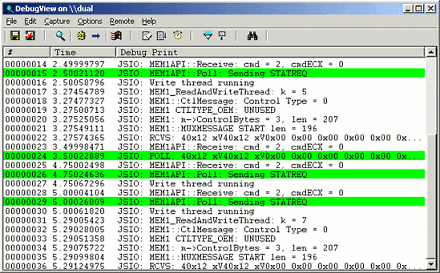
DebugView is an application that allows you to monitor debug output on your local system or on any computer on a network accessible via TCP/IP.
Earlier .NET frameworks did not natively support single-file publishing of final compiled output (requiring third-party tools).